Destratification fans energy savings?
Destratification fans energy savings? For most commercial applications, a fair working average is around 20% heating energy saving, with good high-bay installations often falling in the 15–30% range. We are cautious about quoting one fixed figure because the saving depends heavily on ceiling height, temperature difference between floor and roof, heater type, control strategy, insulation level, door openings and fan running hours.
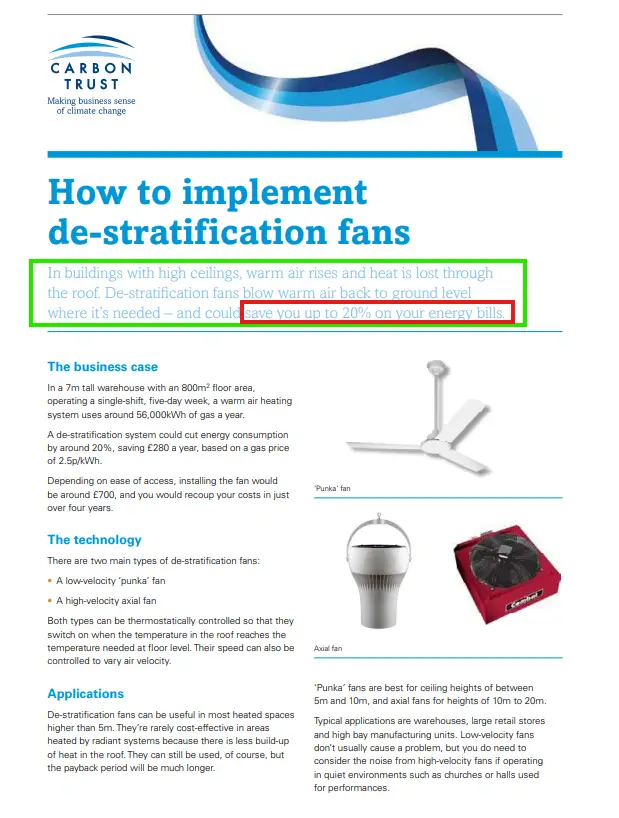
The most commonly quoted figure is the Carbon Trust’s 20% saving. In its HVAC guidance (pictured below), the Carbon Trust states that in commercial or industrial buildings with warm air heaters and high ceilings, de-stratification fans can reduce energy use by 20% by blowing warm air back down to ground level. A Carbon Trust implementation guide also provides a worked example of a 7 m tall, 800 m² warehouse using about 56,000 kWh of gas per year, where a destratification system could cut energy consumption by around 20%.
Destratification fan energy savings figures, Energy Saving Trust data
There are also measured study figures. A paper from the 2009 ASHRAE Annual Conference, listed by the International Institute of Refrigeration, reported that five destratification fans in a warehouse reduced ceiling temperatures by 4.0°C, raised floor temperature by 1.5°C, and achieved an average 19.3% gas saving over the test period. It also noted that the electrical consumption of the fan motors represented only about 5% of the total cost savings, so the net benefit was still strong. Credit and report source – IIFIIR.ORG
A Concordia University thesis reviewing warehouse destratification studies cites two useful figures: a 26.4% reduction in gas usage from destratification in a distribution warehouse, reported by Aynsley, and the 19.3% heating energy reduction from Armstrong et al. It also notes that, in aircraft hangars, an 8°C vertical temperature difference could require 38% extra heating energy if no destratification is used.
Leisure & Sports Centres: High ceilings in leisure facilities can yield extreme savings, with some large aquatic centres or sports halls achieving reductions of 40% to 60% due to severe initial heat trapping.
Our full range of destratification fans are listed here – Flexiheat Destratification Fan Range
Thus, for a practical heating-engineering answer, we quote 20% as the safe average, 19–26% as study-backed measured performance, and up to 30%+ only where the building has strong stratification and the fans are properly selected, positioned and thermostatically controlled. The highest savings are normally in warehouses, factories, sports halls, workshops and retail units with high ceilings and warm-air heating.


