
 Flexiheat UK
External combi boilers – Natural gas or LPG-fired
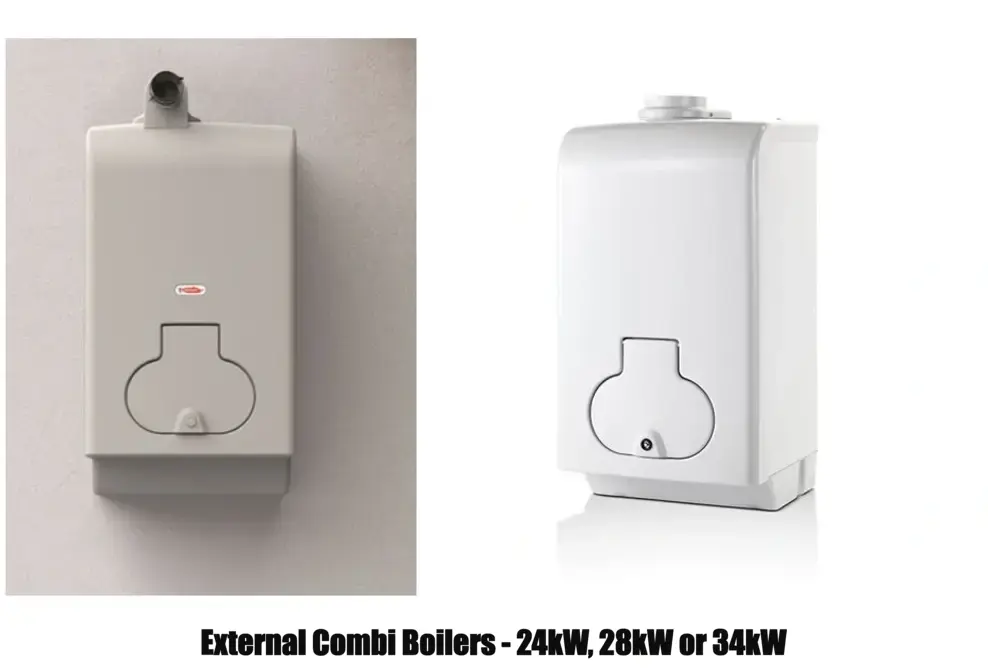
External Combination Boilers – gas-fired, natural gas or LPG (propane)
External combi boilers provide both central heating and instant hot water without the need for a hot water cylinder. Combination boilers are the most popular type of boiler in the UK and Ireland due to their high efficiency for both heating and hot water production and easy operation and installation. Our external combi boiler versions are available in either natural gas or LPG (propane)-powered options, with excellent hot water performances and incredible space heating efficiencies with built in frost protection, with an external powder-coated casing, and are a highly efficient great alternative to oil boilers.
As standard, our gas-fired outside or outdoor combi boiler products are manufactured to ErP Class “A” ratings for high efficiency heating & domestic hot water.
Our external combination gas boilers have an IP5XD weatherproof rating (for protection against rain and weather) and an antifreeze protection system that automatically starts the boiler when the internal water temperature in the stainless steel heat exchanger falls below 8°C, firing up the boiler until the water temperature reaches 30°C within the heat exchanger and preventing it from freezing, as long as you have the gas supply and the power supply available.
With the addition of ethylene glycol (anti-freeze) to the heating system, you can protect the boiler down to a temperature of minus 50°C when using a 60% anti-freeze mix.
Advantages of outside combi boilers
An external combination boiler is a type of combination boiler that is designed to be installed outside the property, in a durable casing designed to be weatherproof. This provides one unit for both central heating and domestic hot water without the need for a separate hot water cylinder or cold water storage tank.
One of the big advantages is saving space indoors. The boiler is externally located to allow space within the home, utility room, garage or plant area. This is especially useful in smaller homes, workshops, offices or properties with limited internal space.
This also means less noise in your home. Because the boiler is external, it keeps normal operational noises out of the living or working space. This makes it a particularly suitable choice and a great alternative for homes where the boiler would be near to bedrooms, kitchens or occupied rooms otherwise.
Outside gas-fired combi-boilers can also make servicing and maintenance easier, as the engineer can often access the boiler without needing to enter the property. It is a perfect option for landlords, commercial properties, holiday lets and rural properties.
They are also useful when replacing older heating systems, especially where there is no suitable indoor wall space, flue route or plant room available. The outer casing protects the boiler from the weather and enables it to operate safely outdoors.
Off-gas areas often have external LPG combi boilers which provide both heating and hot water in one small outdoor appliance.
Simply put, the main benefits of an external combi boiler are space saving, quieter operation in the home, easier access for servicing, installation flexibility and no need for a separate hot water cylinder. They are a practical choice if internal space, noise or flue positioning is problematic.
Greatly reduce the risk of carbon monoxide poisoning
Unfortunately, it is commonly reported that around 7 people a year die in the UK from carbon monoxide poisoning caused by poorly fitted, maintained or vented gas appliances and flues. This is the figure provided by the Health and Safety Executive (HSE).
Because the boiler is located externally, it significantly reduces the risk of carbon monoxide (and thus carbon monoxide poisoning) entering the building compared with an internally installed gas boiler. However, correct flue positioning, installation, servicing and annual safety checks are still essential, as no gas appliance can be described as completely risk-free.
Additional benefits of mounting the combi boiler higher up on the wall
The primary benefit is flood protection. By placing the boiler above the expected flood level, the risk of flood water reaching the burner, fan, PCB, gas valve, pump, heat exchanger and electrical components is reduced.
This can lessen the likelihood of a total boiler breakdown following floods and can allow the home to recover more rapidly. The UK flood resilience guideline often stresses limiting damage and speeding up recovery during floods. Government flood-risk advice also often suggests raising sensitive parts of buildings above the expected flood levels when possible. You can do this with our
Please bear in mind that you must also provide safe service access, especially if you mount the boiler high up. The gas, electrical and condensate pipework also needs protection from frost, weather and potential flood damage.
Damage protection / avoidance
A high-level mounted outdoor combi boiler can also assist with security and with unintentional damage. When you mount it out of easy reach, it is less likely that cars, storage items or garden equipment will knock, tamper with, vandalise or destroy it.
External combination boiler sizing
The main considerations when sizing an external combination boiler are the property’s heating demand and domestic hot water demand.
Heating system demand
The first thing to sort is the space heating load: the boiler must be powerful enough to heat the building on the coldest days of the year. Don’t believe the hype about just counting the radiators; a proper heat loss calculation is always the way forward.
The major benefit of our external combi-boiler range is their ability to modulate output, meaning they can adjust the boiler’s output performance to match the heating demand, which is essential for reducing your heating bills and household comfort.
For example,
24kW combi boiler version
Our 24 kW external combi boiler will ramp all the way down to a minimum of 2.75 kW of heating output if run on an 80/60°C heating circuit or 3.02 kW if run on a 50/30°C heating circuit (it works in full condensing mode, recovering a lot of latent heat from the flue gases at these temperatures – hence the larger kW output figure).
28kW combi boiler version
Our 28 kW external combi boiler will ramp all the way down to a minimum of 3.52 kW of heating output if run on an 80/60°C heating circuit or 3.83 kW if run on a 50/30°C heating circuit, i.e., in full condensing heating mode, as mentioned above.
34kW combi boiler version
Our 34 kW external combination boiler will ramp all the way down to a minimum of 3.94 kW of heating output if run on an 80/60°C heating circuit or 4.34 kW if run on a 50/30°C heating circuit, i.e., in full condensing heating mode.
So in short, all of our outside combi boilers can modulate down to very low levels of heating output, which means you can’t really oversize them for the heating side of things. It’s the domestic hot water requirements that really decide what output combination boiler you will require.
Hot water heating demand
Next up is domestic hot water demand, which tends to be the main factor these days for sizing externally mounted combi boilers. Because a combi boiler produces hot water instantaneously, its output has a direct impact on the hot water flow rate. A small one-bathroom place might get by with a small combi, but a big house with loads of bathrooms or high hot water usage needs something more powerful.
In some cases, a combi just isn’t the right fit; a system boiler with an unvented cylinder might be a better bet (we also supply these gas-fired external system boilers – please see this webpage) External gas boilers – and we also supply the indirect unvented hot water cylinders – please see this webpage: Unvented indirect hot water cylinders
We always recommend sizing on the coldest mains water temperature, which tends to be 10°C for most of the UK; however, for Scotland and Northern Ireland, the lowest cold water incoming temperature can be as low as 5°C in the winter months.
So use the temperature rise (shown in the below DHW performance chart as “ΔT”) of 30°C for the majority of the UK, and please use 35°C for Scotland and Northern Ireland
I.E., our 24 kW combination gas boiler for external mounting will produce 11.2 litres per minute in winter-time conditions for most locations in the UK, and for Scotland and Northern Ireland, this would be 9.6 litres per minute. In the summer, when the cold mains water entering the property is warmer (with a delta T of 25°C), the flow rate is 13.5 litres per minute.
Also shown are the DHW performances for the 28 kW and 34 kW combination gas-fired external boilers at the various DHW temperature rises.
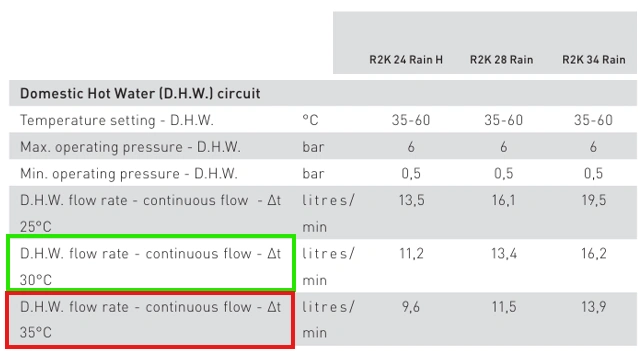
Gas-fired external combi-boilers: domestic hot water performance data from Flexiheat UK
Hot water outlet flow rates
A typical showerhead requires seven or eight litres of hot water per minute, while “green band” showerheads require six litres.

Standard showerhead with a 7 to 8 litres a minute flow rate of 40°C hot water
Please be advised that drench showers can have extremely high flow rates, ranging from 15 litres to almost anything; 30 litres per minute is not unusual.

Drench showers with hot water flow rates from 15 to 30 litres a minute or even more
If you have a “drench shower”, it’s best to use our external system boilers and an indirect hot water cylinder installation.
Other hot water outlets’ flow rates
Taps in kitchen sinks: 4 to 6 litres per minute
Standard washbasin taps: 4 litres per minute.
Water-saving “spray taps” for basins and cloakrooms, 2 litres per minute,
Bath mixer taps: The demand rate for modern bath taps is around 12 litres per minute.
You may thus determine your hot water demand by combining all your possible hot water outlets and then using a diversity factor, which accounts for the fact that not all outlets will be used simultaneously.
Combi boiler product options
We have three models in our outdoor combi-boiler range: a 24 kW, 28 kW, or 34 kW model, all of which can be supplied for either natural gas or propane (LPG) gas, i.e., an external LPG combi boiler.
The appropriate manuals are here for direct download:
24kW R2K Rain external gas combination boiler manual (H version) from Flexiheat UK
28kW and 34kW Rain external gas combination boilers manual from Flexiheat UK
All units have the same external dimensions; just the boiler (heat exchanger) inside is different. These dimensions are

Dimension details of our external or outdoor gas-fired combination boilers: all boilers come with a built-in pump and expansion vessel from Flexiheat UK
Heat exchanger
The heat exchangers of our exterior combination gas boilers are made from 28 mm stainless steel tubes without weld joints, which gives the best corrosion resistance, prevents clogging, and provides the following benefits:
- A large water flow heat exchanger with a diameter of 28 mm (much larger than normal heat exchangers used in combi boilers) with a great heat exchange surface for excellent hot water performance and incredible space heating efficiencies.
- High operating pressure: the heat exchanger’s heating side can reach up to 3 bar, while the domestic hot water side can reach up to 6 bar of pressure.
- Low pressure drops

External Gas Boiler Heat Exchanger – Made from stainless steel with large waterways – 28mm
Flue options
99% of our customers go for the following flue kit – known as the “frontal flue kit”. This is pictured below.

Frontal flue kit for rain external boilers and water heaters from Flexiheat UK
However, we can also supply a vertical or horizontal flue kit if so required.
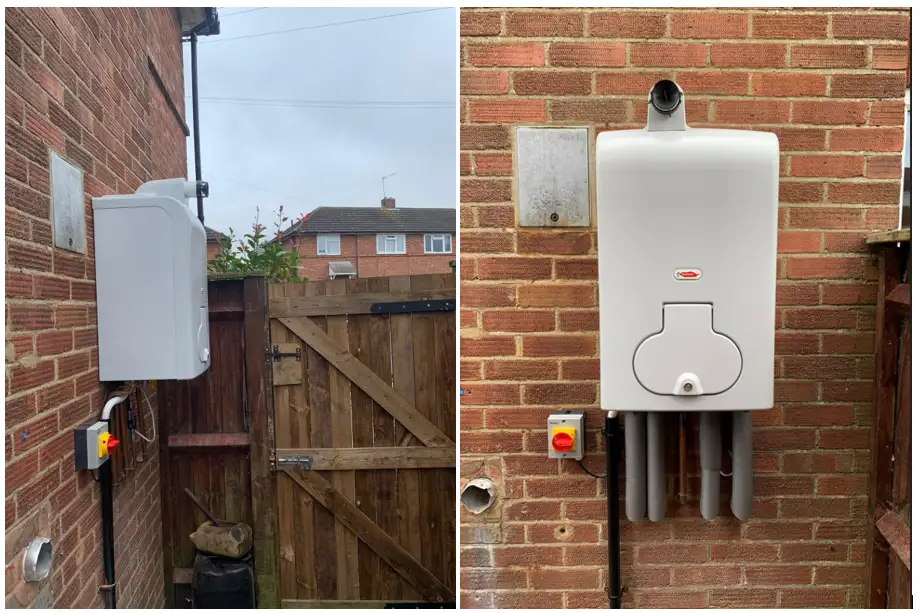
External boiler install picture in Salisbury, UK – please note the customer didn’t use the provided pipework cover kit that we supply because he wanted to pick up certain connections in the existing heating system.
Control options for the boilers
You can control our combi boilers using the inbuilt LED display control panel. However, as the boiler is outdoors, you don’t want to go outside to open the control panel, so you’ll need a controller inside the property.
The controller can be a simple on/off thermostat which must be a volt-free type, or you can use our recommended controller, the “CloudWarm”. This is a mobile controller that you can move from room to room and adjust your desired temperature from the comfort of your settee, chair, etc.
Everyone now wants to control their boiler when out and about, whether travelling, at work, or even on a plane – being able to turn it on and warm the house for your return has become almost standard. Well, the good news is that our combi boilers can do just that – they have a control thermostat/panel called the “Cloud Warm”, which is an “OpenTherm Plus” compatible controller, meaning you can control these combi boilers on the go.
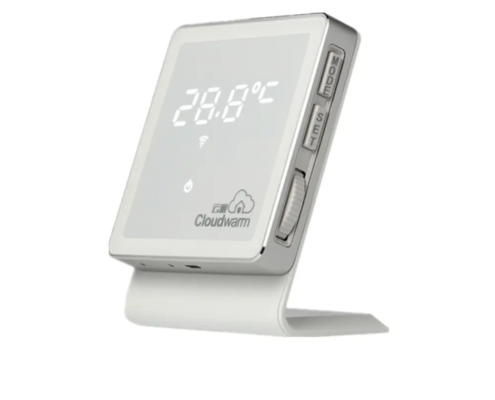
OpenTherm controller Wi-Fi app controlled from Flexiheat UK
Cloud Warm – a wireless Wi-Fi controller – our external boilers can be controlled via a phone, iPad or computer app.
This feature means you can make your life simpler and control these combination boilers from either your mobile phone (Android or Apple) or your PC or tablet, from anywhere in the world, as long as you have an internet connection.
What can you do with the app?

Cloud Warm App – control your boiler on the go!
With the Cloud Warm app, you can manage your home comfort directly from your smartphone or tablet (Android or Apple). With just a touch of your finger, you can set your comfort level; the app allows you to control, regulate, and programme all the parameters for managing your heating system.
- In the event of failure or an anomaly, errors can be reset remotely, thus restoring normal boiler operations and re-establishing domestic comfort.
- You can choose thermoregulation, which keeps a consistent indoor temperature even when the outside temperature changes, by using the outside temperature sensor and internal remote control to save money and improve comfort. The heating operation is therefore modulated according to the outdoor temperature and the user’s settings.
This function, which can be managed remotely, reduces unnecessary energy consumption and saves money.
Oil boilers?
Why use an external gas combi boiler over an oil boiler version?
Gas boilers also avoid the need for a large oil storage tank. With an external oil boiler, the property still needs an oil tank, base, pipework, fire separation clearances and periodic checks. A gas boiler, especially on mains gas, removes the need to monitor fuel levels, arrange oil deliveries, or worry about running out during winter.
In terms of maintenance, gas boilers are often simpler and cleaner to service. Oil boilers require oil filters, nozzles, pump pressure checks and combustion adjustment. Gas boilers still need annual servicing, but they generally involve less messy fuel handling.
Running costs can also favour gas, particularly where mains natural gas is available. Oil prices can fluctuate significantly and depend on delivery costs, order quantity and seasonal demand. Mains gas is usually more convenient and often cheaper per unit of heat than heating oil.
Outdoor combination boilers for sale in the UK & Ireland
If you require any further assistance or more information on our outside / outdoor / external combi boilers, please click here to contact us via email or call us directly on 01202 822221.


 Flexiheat UK