
 Flexiheat UK
 What is stratification in water heaters?
What is stratification in water heaters? Because hot and cold water have different densities, temperature stratification in water heaters causes the water to be stacked in layers of warm and cold water rather than being uniformly heated throughout the vessel. Legionella bacteria can thrive at temperatures between 20 and 45 degrees Celsius thanks to stratification in water heaters. Serious illnesses may result from this process.
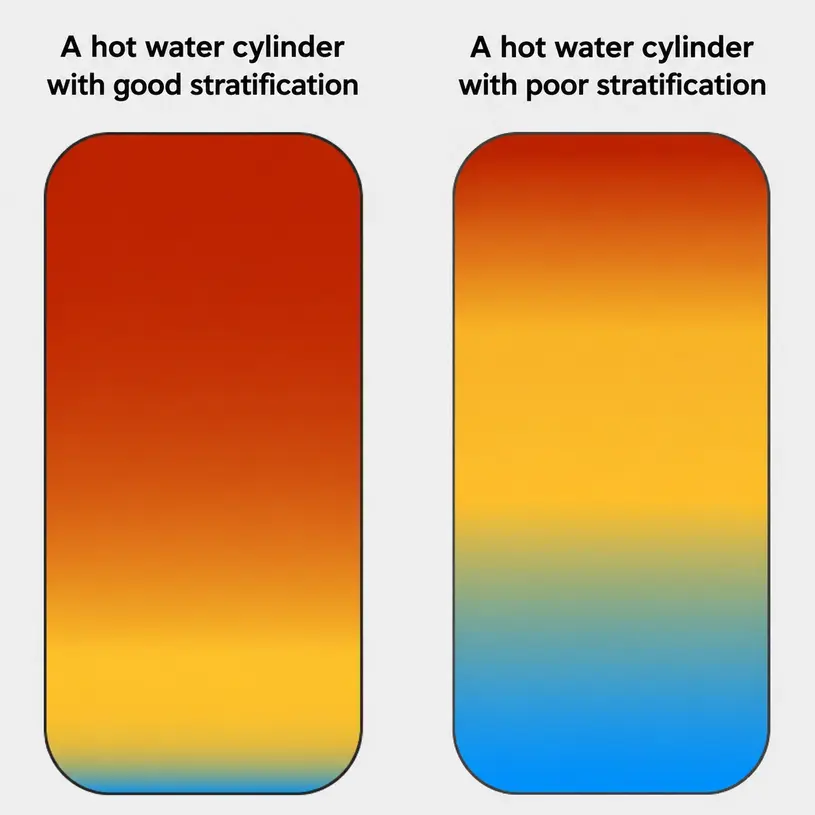
Stratification in hot water cylinders
“Stratification” is the term for this layering effect. The unique link between water’s density and temperature causes stratification. In contrast to nearly every other liquid, water has a maximum density at 4 degrees Celsius and a decreasing density at both higher and lower temperatures.
At what litreage does stratification become a potential issue in a hot water cylinder?
There is no fixed tank volume where stratification suddenly becomes a problem in a hot water cylinder. Stratification can occur in almost any stored hot water vessel, but whether it is beneficial or problematic depends on the cylinder design, height-to-diameter ratio, heat source, coil position, flow rates, draw-off pattern and controls.
In simple terms, stratification means the hotter water sits at the top of the cylinder and cooler water remains lower down. This is normally beneficial, because hot water is drawn from the top of the cylinder first. A well-designed vertical cylinder should encourage stable stratification.
As a practical rule, stratification becomes more important to consider as cylinders increase in size, especially from around 300 to 500 litres and above. At this size and above, particularly in commercial hot water cylinders, poor stratification can cause uneven temperatures, reduce usable hot water, prolong recovery times, and create colder areas in the lower part of the vessel.
Commercial cylinders
For larger cylinders, especially those of 500 litres and above, the design of the cylinder is very important. The location of the heating coil, immersion heater, thermostat pocket, return connection and cold water inlet can all affect how evenly the stored water heats. The hot water association’s testing guidance for cylinders assesses hot water performance by measuring the volume of water drawn off above 40°C, and requires at least 70% of the net storage capacity to be available as hot water at 40°C or above, showing that usable hot water volume is not just about the nominal litre size.
In commercial systems, stratification also is relevant for hygiene and legionella control. HSE guidance states that hot water should be stored at at least 60°C and distributed so that it reaches 50°C at outlets within one minute, or 55°C in healthcare premises.
So, while there is no exact litre cut-off, stratification should be carefully considered on cylinders above 300 litres and treated as a key design issue on 500-litre- and larger commercial hot water storage vessels.
So how do you prevent or remedy stratification
You install a de-stratification pump on the system (often called a calorifier shunt pump) . A de-stratification pump forces the hot and cold water to mix, producing warm water that stabilises the temperature of the cylinder’s contents. It should periodically mix the stored domestic hot water so that the cooler water at the bottom of the cylinder is brought up to a safe temperature.
The below diagram shows the set up for an indirect hot water cylinder, but it’s the same for a direct hot water cylinder as well.
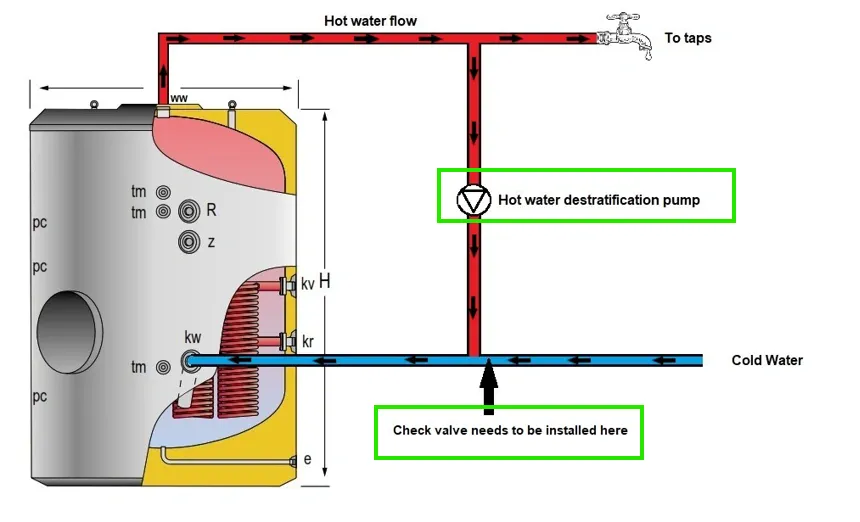
Hot water destratification pump piping schematic by Flexiheat UK
Operation set up for the destratification pump
Set the pump to operate for one hour in the early morning, when there is no demand, to de-stratify the tank.
Some other notes
To prevent stratification within the cylinder, a top-to-bottom recirculation pump can be fitted. It is possible to control the pump recirculation according to the control strategy deployed on site.
Full-time operation of the recirculation pump may be considered where a single heat source is used (see note below, as it also has its downsides), and a uniform water temperature is required throughout the cylinder.
Alternatively, intermittent use of the pump may be considered where dual heat sources are used and deliberate stratification within the cylinder is desirable.
For efficient operation with some renewable energy sources, the top-to-bottom recirculation pump should only operate to coincide with the timed raising of the water temperature as part of the anti-legionella regime.
The pump should not normally run continuously
Continuous operation is generally undesirable because it:
- Destroys useful temperature stratification;
- Increases standing and circulation heat losses;
- Can reduce the immediately available quantity of high-temperature water;
- May cause the cylinder thermostat and heat source to cycle unnecessarily.
For solar and similar calorifiers, HSE guidance specifically states that the shunt pump should not operate continuously and should normally run for approximately one hour daily under time-clock control.
How many times should the volume of water in the cylinder be turned over?
There is no fixed UK regulatory requirement stating that a de-stratification pump must turn over the cylinder a specific number of times per hour. The compliance target is temperature-based: the pump and heat source must enable the whole cylinder, including its base, to reach at least 60°C and remain at that temperature for one continuous hour.
As a practical design basis, we would normally allow approximately:
Two to three equivalent cylinder-volume turnovers during the mixing period
The required pump flow can be estimated as:
Pump flow rate = cylinder volume × required turnovers ÷ operating time
For a one-hour pump cycle:
| Cylinder volume | Two turnovers | Three turnovers |
|---|---|---|
| 300 litres | 600 L/h — 10 L/min | 900 L/h — 15 L/min |
| 500 litres | 1,000 L/h — 16.7 L/min | 1,500 L/h — 25 L/min |
| 1,000 litres | 2,000 L/h — 33.3 L/min | 3,000 L/h — 50 L/min |
| 2,000 litres | 4,000 L/h — 66.7 L/min | 6,000 L/h — 100 L/min |
Two turnovers per hour is generally a sensible starting point for a properly arranged cylinder with a top draw-off and a low-level return. For a tall cylinder, a large commercial calorifier or an installation with persistent temperature differences, a design closer to three turnovers per hour may be more appropriate.
However, the pump should not be selected solely on the basis of cylinder volume. It must provide the calculated flow rate against the actual resistance of the pipework, valves and fittings. Excessive flow can create turbulence, noise or hydraulic short-circuiting without necessarily improving temperature distribution.
Most importantly, the one-hour disinfection period should begin when the bottom temperature sensor reaches 60°C, not simply when the pump starts. The final commissioning test is therefore whether the top and bottom of the vessel both remain at or above 60°C for the required period—not merely whether a theoretical number of turnovers has occurred. HSE guidance also requires the heat source to operate while the shunt pump is active.


