
100 Litre buffer tank
100 Litre buffer tank

100 litre buffer tank or vessel in 304 stainless steel from Flexiheat UK
Our 100 litre buffer tank, which is manufactured from 304 grade stainless steel, is rated for a maximum 6 bar working pressure and a maximum temperature of 95°C. With premium polyurethane foam insulation for minimal heat loss, they also have a class-leading ErP insulation rating of “A”; similar products are rated “B” at the very best. These buffer tanks are designed for heating and cooling systems and come with four x 32 mm (1 1/4″) main connections for easy installation.
Not only does the unit serve as a buffer to hold extra volume (the buffer storing additional volume of the heating or cooling medium, such as a water glycol mix), which helps improve the operating efficiency of the heat pump system by reducing on/off cycling of the compressor unit of the heat pump, but it also acts as a hydraulic separator to keep the primary and secondary circuits separated if so required.
Heat pump systems
They are generally used in heating systems for heat pumps, whether air source or ground source. These 100 litre buffer tanks also can be used for biomass boilers or solar heating systems as well. This 100-litre capacity buffer tank comes with an immersion heater port for an additional heat source.
100 Litre buffer vessel product details
Our 100 litre buffer vessel/tank with an ErP insulation rating of “A” for minimal heat loss features the following technical details:
Specifications of the buffer tank
The main specifications for our 100 litre buffer vessel/buffer tank are as follows:
| Specification | 100 Litre |
| Inner tank material | 304 grade stainless steel |
| Insulation | 50 mm rigid polyurethane foam, CFC-free premium polyurethane foam insulation |
| Cylinder casing | Frosted metal, colour RAL 7030 |
| Maximum operating pressure | 6 bar static pressure |
| Maximum operating temperature | 95°C |
| Empty Weight | 22 kg |
These units are suitable for a water glycol mix of up to 50%.
Stainless steel buffer tanks have no internal enamel or painted coating that can become damaged or deteriorate.
Dimensions of the 100 litre buffer tanks
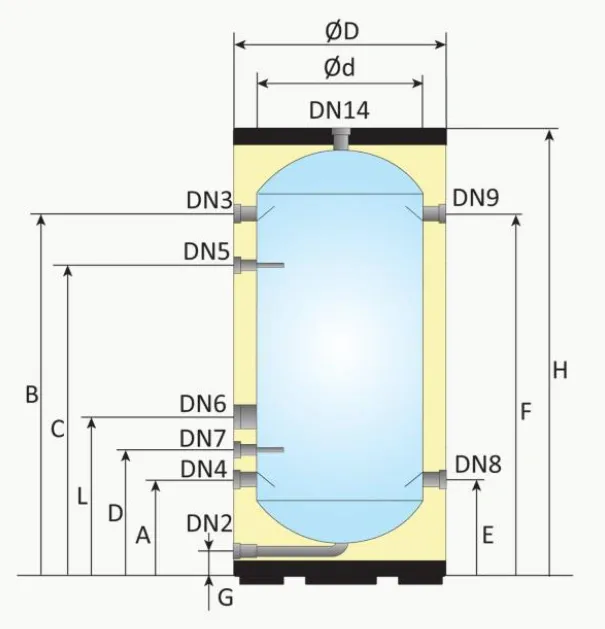
100l buffer tank connections and port details from Flexiheat UK
| Ref. | DN | Connection | Description | Dimension size |
| H | — | All female | Buffer tank – total height | 995 mm |
| ØD | — | — | Buffer tank outside diameter | 470 mm |
| Ød | — | — | Buffer tank inside diameter | 370 mm |
| H | DN 14 | G 3/4″ | Pressure relief valve / venting | 995 mm |
| B | DN 3 | G 1 1/4″ | Connection (Inlet/Outlet) | 800 mm |
| F | DN 9 | G 1 1/4″ | Connection (Inlet/Outlet) | 800 mm |
| C | DN 5 | G 1/2″ | Temperature sensor port | 700 mm |
| D | DN 7 | G 1/2″ | Temperature sensor port | 300 mm |
| L | DN 6 | G 1 1/2″ | Immersion heater port | 360 mm |
| A | DN 4 | G 1 1/4″ | Connection (Inlet/Outlet) | 200 mm |
| E | DN 8 | G 1 1/4″ | Connection (Inlet/Outlet) | 200 mm |
| G | DN 2 | G 1/2″ | Drain port | 33 mm |
Our manufacturer part number for this 304 stainless steel 100 litre buffer tank is FH2032001020. Our next size-up unit is a 200 litre model; this is detailed here –200 litre buffer tank
Our premium polyurethane foam insulation with minimal heat loss that insulates this buffer tank means that you can use it on both hot and cold water systems, i.e., chilled water
The immersion heater port is intended to accommodate an immersion heater, either as a backup heat source or to assist in heating the buffer vessel when the heat pump is in a defrost cycle.

Front view of our 100 litre buffer tank in 304 stainless steel showing port locations – Flexiheat UK
Stainless steel construction – what are the benefits?
A stainless steel buffer tank is generally considered better than a mild steel buffer tank because it offers much greater corrosion resistance and can provide a longer, lower-maintenance service life.
Other advantages of stainless steel include:
- Longer potential service life when correctly installed.
- Stainless steel buffer tanks have no internal enamel or painted coating that can become damaged or deteriorate.
- Reduced production of rust, magnetite and corrosion debris.
- A smoother internal surface that can help keep the heating water cleaner.
- Excellent suitability for heating and chilled-water systems.
- Good resistance to external corrosion, which is useful where chilled-water tanks are exposed to condensation.
- Stainless tanks can often use thinner wall sections, reducing vessel weight.
However, mild steel remains perfectly suitable for many correctly designed and maintained sealed heating systems.
Mild steel construction and the cons of it for a buffer tank
Mild steel construction buffer tanks installed in a properly commissioned closed heating system – the oxygen content of the water quickly becomes very low. With a suitable corrosion inhibitor, correct pressurisation and minimal fresh-water top-up, a quality mild-steel buffer tank can achieve a long working life.
The problems tend to arise where systems continually take in fresh oxygenated water through leaks, automatic filling arrangements or poor maintenance of the heating circuit.
Your heating system and the cost of quality
For most heating applications, the choice is between initial cost and long-term durability. A mild steel 100 litre buffer tank provides an economical solution for a correctly maintained closed system, whereas a stainless steel 100 litre buffer tank offers greater corrosion resistance, reduced maintenance risk and potentially much longer buffer tank life.
Ultimately you spend thousands of pounds on a heat pump; the last thing you want is the heat exchanger blocking up with debris (rust particles, etc. that you can get with a neglected heating system with a steel buffer tank), and because air source heat pumps rely on strict flow rates and temperature balances, a blockage will trigger immediate performance drops or system shut-offs.
Top tips for air source heat pumps installation
A properly sized thermal expansion vessel is a common safety component in buffer tank setups.
These units have a quantity of four main ports that can act as a hydraulic separator for the heating circuit. Separating the primary and secondary circuits, i.e., separating the heat pump as the primary heating circuit and the secondary circuits, such as radiators or underfloor heating circuits, are generally used in heating systems for heat pumps, whether air source or ground source, etc.
Installing a buffer tank requires an appropriate hydraulic piping configuration for efficiency.
Check the maximum working pressure and operating temperature for compatibility with the heating system
Air trapped in a buffer tank can reduce heat transfer efficiency.
Routine maintenance of a buffer tank should include checking for leaks and monitoring pressure.
A buffer vessel can store thermal energy captured during off-peak time.
Contact us for your hot and chilled water buffer tank 100 Litre capacity requirements
If you require further information, confirm any questions, check product availability and stock levels, get a quote, find delivery times, find prices or order our 100 Litre buffer tank designed for heat pumps (which has the main function of improving the operating efficiency of heat pump systems by reducing compressor pump short cycling, as the buffer function reduces the heat pump’s on/off cycles for hot or cold water production) or boilers, and acting as a hydraulic separator.
You are welcome to contact our customer sales team on this number, 01202 822221, or use our email contact form to get in touch. We deal with the UK and Ireland.


 Flexiheat UK