
 Flexiheat UK
Indirect vented hot water cylinders

An indirect vented hot water cylinder uses an external source, such as a gas boiler, oil boiler, solid fuel boiler, heat pump systems or even solar thermal systems, as the main heat source to heat water indirectly via a heat exchanger coil. The vent pipe prevents pressure buildup as water heats and expands.
A vented cylinder uses gravity to take cold water from a tank. This cold water storage tank is typically located in the loft of a property and feeds it into the hot water cylinder, meaning they are not dependent on the incoming mains pressure to deliver hot water at a good flow rate, unlike unvented hot water cylinders.
Because they rely on a loft cold-water cistern and gravity instead of a sealed mains-pressure installation with the additional safety components unvented indirect cylinder systems need, vented cylinders are generally less expensive than unvented cylinders, and the entire system is usually simpler and cheaper to install.
An indirect vented cylinder is required for a solid-fuel boiler. In practice most hot water installations are open-vented because solid fuel keeps producing heat after the fire is established, so overheating protection is critical for these indirect cylinders. Thus, you must use an open-vented indirect hot water cylinder on solid fuel heat sources.
Our vented indirect hot water cylinder range is manufactured in the highest quality duplex stainless steel and comes supplied with factory-fitted insulation for very low heat loss. Thus, these indirect vented cylinders have an ErP energy efficiency rating of Class “A” for the 200 to 500 litre indirect cylinder vented models. They have polyurethane foam insulation as standard.
With a range of vented hot water indirect water heaters from 140 litres to 1,500 litres, we can cover all requirements by connecting water heaters in parallel if so required for larger volume requirements.
Duplex stainless steel construction
Duplex stainless steel-manufactured hot water cylinders are now more popular than copper-vented cylinders. Due to the thickness of the stainless steel we use to manufacture the cylinders, our vented cylinders are rated to a maximum working pressure of 6 bar, which is equivalent to 60 metres of static “head of water” pressure. This feature allows them to be fitted into basements in very high properties or buildings. The stainless steel cylinder has a maximum operating temperature of 95°C.
The heat exchanger indirect coils of these stainless steel vented indirect hot water cylinders are manufactured from 316 stainless steel and are rated for a maximum operating temperature of 120°C and a maximum working pressure of 10 bar.
Copper hot water cylinders, on the other hand, are rated for a maximum working head of 10 to 25 metres, which equates to 1.0 to 2.5 bar, depending on the grade of copper used and the capacity of the open vented indirect cylinder.
Stainless steel has superior durability, corrosion resistance (especially in soft water areas), and a longer lifespan.
What is a vented hot water cylinder?
A vented cylinder uses gravity to take cold water from a tank, typically in the loft space, and feed it into the cylinder, hence the term “gravity-fed hot water system”. For everyday water consumption throughout the house, this simple water heating system guarantees a consistent and dependable supply of hot water.
Gravity-fed hot water system
Gravity feed: vented cylinders rely on the elevation of the water tank to produce the pressure for your hot water taps, showers or bath, i.e., the distance of this tank above the indirect hot water cylinder. This is referred to as the static head and gives you your vented hot water pressure.

Vented hot water cylinder diagram set up by Flexiheat UK – showing the feed and expansion cistern that is required for the open vent pipe and cold feed pipe etc.
Unlike unvented cylinders, which use the mains water supply to provide the hot water system with the pressure for the hot water system.
Vented cylinders are better suited to older or traditional heating systems
Vented cylinders are the traditional arrangement for conventional boiler systems, especially in older UK homes that are already set up with a feed-and-expansion / cold-water tank arrangement or where building regulations require vented systems to deliver hot water.
Open vented indirect hot water cylinder range
Standard coil heat exchanger capacity – for boilers with an 80°C/60°C flow and return heating system.
Our standard coil open vented indirect hot water cylinders have a much larger heat exchanger surface area than those of our competitors’ cylinders. For example, our 300-litre indirect vented unit has a 25 kW output, and at the same flow and return temperatures (they use a higher temperature of 85/65°C to make their cylinder look better) from a boiler or other heat source, our competition’s unit is rated at 20 kW.
Our heating power output is approximately 25% larger than that of the competition across our 22 mm and 28 mm standard coil range, as our heated coil imparts more energy into the potable hot water.
DSSC standard coil indirect hot water storage tanks – domestic hot water performance data
This standard coil range is suitable for 95% of domestic properties with standard hot water supply demands.
All these indirect hot water cylinders are rated at a maximum of 6 bar/95°C for the tank and 10 bar/120°C maximum for the heat exchanger coil.
These tanks are all manufactured from duplex stainless steel, hence the “DS” in the model reference.
They are all fitted with one 40 mm (1 1/2″) immersion heater port.
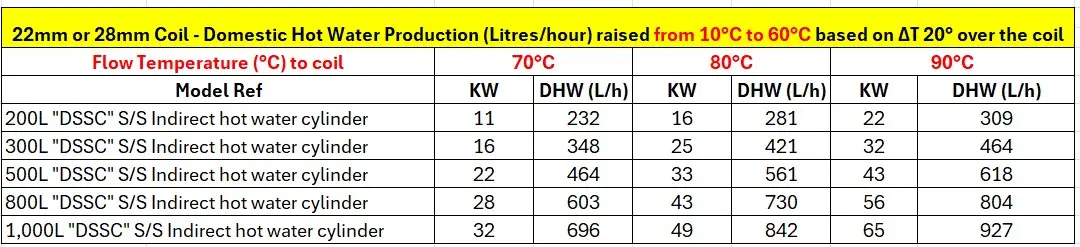
Standard coil indirect open-vented cylinder DHW performance outputs from 10°C to 60°C, at various coil input temperatures – Flexiheat UK: the 200 to 500 litre models have a 22 mm coil; the 800 & 1000 litre models have a 28 mm coil.
Then we have our extra-large coil range for higher water heating requirements
This extra-large coil range is suitable for domestic properties with higher DHW demands or commercial water heating applications.
The “DSXL” extra-large coil indirect hot water storage tanks, all with a 28 mm heat exchanger coil, have the domestic hot water performance data shown below.
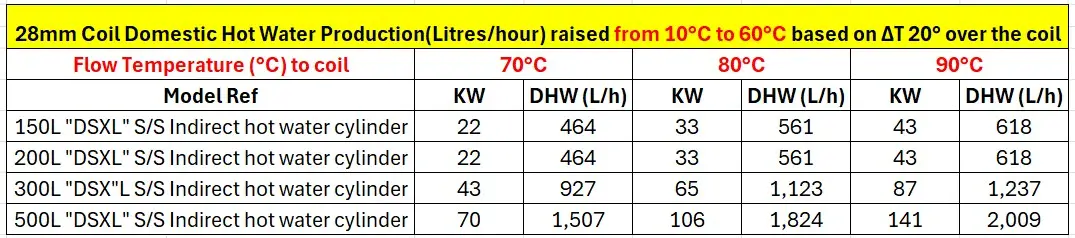
Extra large coil indirect open-vented cylinder dhw performance outputs from 10°C to 60°C, at various coil input temperatures – Flexiheat UK
Lastly we have our double extra-large coil range for ultimate water heating requirements
This double extra-large coil range is suitable for domestic properties with very high DHW demands (think mansions, manor houses, and chateau-style homes) or commercial and industrial water heating applications. They are also particularly suited to heat pump systems, as the larger heat exchanger has lower pressure drops and can extract the maximum heat from the lower flow temperatures associated with heat pumps.
The “DSDXL” double extra-large coil indirect hot water storage tanks (all of this range has a 32 mm heat exchanger coil for extra large heat exchanger surface area) – domestic hot water performance data. This range has a volume of up to 1,500 litres.
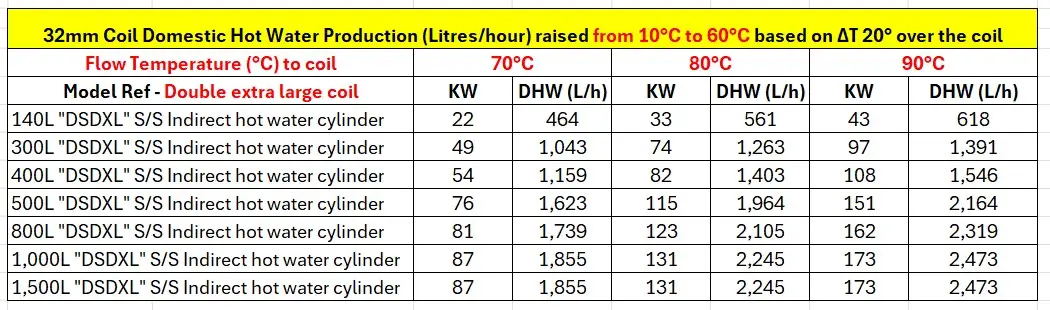
Double extra large coil indirect open-vented cylinder DHW performance outputs from Flexiheat UK
Twin coil open vented cylinders?
Yes, we have a full range of twin coil indirect vented hot water cylinders, suitable for two heat sources feeding the indirect vented cylinder. Our twin coil vented cylinder range are all listed on their own dedicated webpage here – Twin coil cylinders vented or unvented
Insulation levels of our vented cylinders
Our vented indirect cylinder range has high, class-leading insulation levels, which are class “A” for our 200 to 500 litre models, leading to a reduction in energy consumption and costs for your home’s domestic hot water heating system.
Building regulations for vented systems
Part G of UK building regulations requires that vented hot water cylinders be fitted with a thermostat that controls the heat source and prevents the temperature of the stored water from exceeding 100°C at any time.
Features and Pros of open vented indirect cylinders
The indirect vented hot water cylinder system is well understood and reliable, having been standard for many decades.
Indirect vented hot water cylinders are easier to maintain due to their open-vented design.
An indirect vented cylinder is a traditional hot water storage tank fed by gravity from a cold water cistern in the loft.
A cold water tank feeds water via gravity to the bottom of the open vented indirect cylinder.
Indirect vented cylinders use an external heat source via an internal coil, and proper coil size compatibility with the boiler is essential for efficiency.
In plain terms: an indirect-vented cylinder is usually chosen because it is simple, relatively low-cost, boiler-friendly, and practical for older homes or weak mains areas.
The rising price of copper means that copper hot water cylinders are no longer the preferred option, as well as the low-pressure ratings of copper hot water cylinders compared to stainless steel units.
Direct hot water cylinders, on the other hand, use immersion heaters only to heat the water.
Cons of vented cylinders
Vented indirect cylinders typically require a booster pump for power showers due to lower water pressure from gravity.
The cold tank in the loft can freeze in winter, impacting system performance.
Immersion heater options for backup or top-up heating
We have various immersion heater options that can be fitted to our open-vented indirect hot water cylinder range from 3 kW to 9 kW capacity depending on the cylinder capacity, which can be used as a backup to the boiler or allows the property owner to use cheap-tariff electricity to heat the vented DHW hot water cylinder, usually overnight with an indirect vented cylinder with immersion.
Contact Flexiheat UK
For further information on stock availability, request delivery times, pricing or to order our cost-effective and energy-efficient indirect vented hot water cylinder range, the ideal solution for loft space areas in flats, houses or even commercial property water heating schemes.
Please contact our customer sales team at 01202 822221 or use our website’s email contact form to discuss your requirements.


 Flexiheat UK
 Flexiheat UK